Best Roofing Options for Low-Slope Homes
Low-slope roof at 2:12–3:12? Learn when composition shingles are okay, when they’re risky, and why mechanical lock standing seam metal often makes more sense.
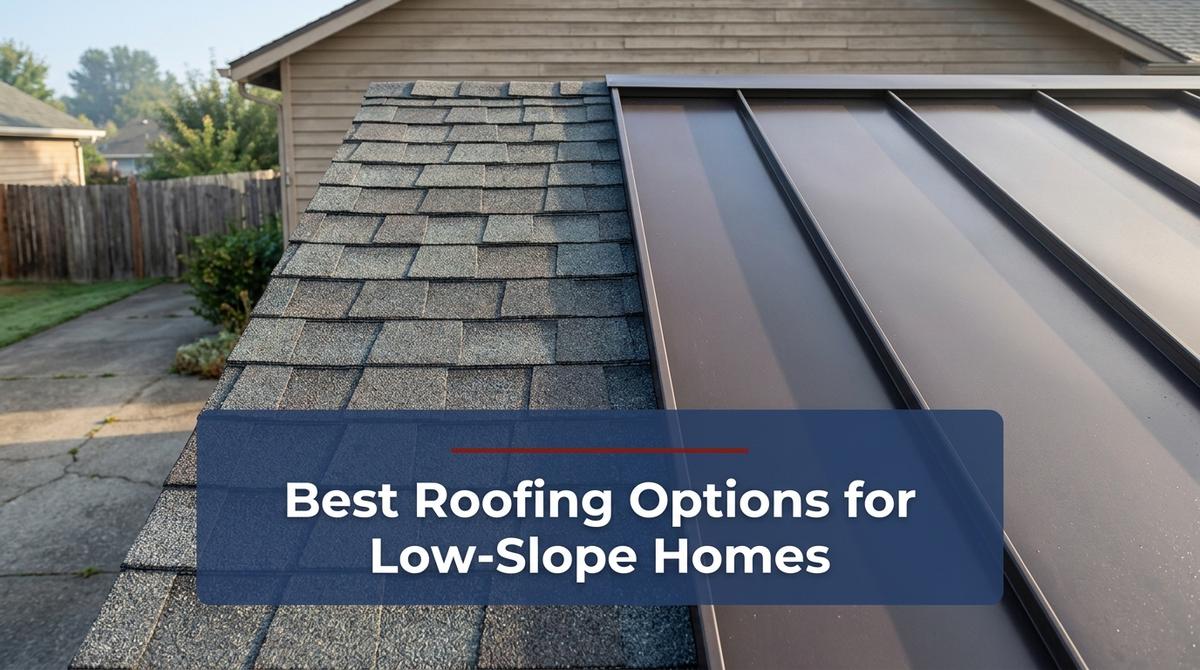
When a Low-Slope Roof Makes You Question Your Shingles
We recently got a call from a homeowner — let's call him Mark — who lives in an older home with a mix of steep and low-slope roof sections. When we got up on Mark’s roof, we saw it was currently covered in composition shingles, including some areas around 3:12 pitch and a few sections that were closer to 2:12.
Mark had heard that newer composition shingles don’t always hold up well on low-slope roofs, especially in our climate, and he was right to be cautious. He asked us if he should stick with composition or switch to standing seam metal, and whether pitch really mattered that much.
That conversation is one we have a lot with homeowners who have low-slope sections on otherwise traditional roofs. So in this post, we’ll walk you through the same explanation we gave Mark — from our boots-on-the-roof perspective.
Why Roof Pitch Matters More Than Most People Think
One of the first things we explained to Mark, standing there on his roof, is that roofing products are designed around pitch. Pitch is simply how steep the roof is — for example, 3:12 means the roof rises 3 inches for every 12 inches of horizontal run.
Here’s why that matters:
- Steeper roofs shed water quickly. Gravity does most of the work, so shingles and metal panels mainly guide the water off the roof.
- Low-slope roofs hang on to water longer. Water can move more slowly, “pond” in spots, and back up under laps and seams if the system isn’t designed for it.
That’s why most composition shingle manufacturers have a minimum recommended pitch (often 2:12 with special underlayment, but more commonly 3:12 and above for standard installations). Below those limits, you’re working outside what the product was intended to do — and that’s usually not the kind of gamble we want to take with our customers’ homes.
Composition Shingles on Low-Slope Roofs: Where They Work (and Don’t)
On Mark’s house, we had both worlds: some nice steep sections where composition shingles shine, and some marginal low-slope areas that raised red flags. Here’s how we broke it down for him.
Where composition shingles are a good fit
We typically like composition shingles when:
- The pitch is 3:12 or higher (and ideally steeper).
- You want a traditional look that matches neighboring homes.
- You’re watching budget more than maximum longevity.
On Mark’s steeper sections, we told him composition was still a solid option. It’s cost-effective, familiar, and with good underlayment and installation, it performs well on appropriate slopes.
Where composition starts to struggle
The closer you get to 2:12, the more we start to worry about:
- Wind-driven rain working up under the shingle laps.
- Ice and snow melt creeping backward under the tabs.
- Manufacturer warranty issues if the pitch is below their published minimum.
We explained to Mark that while some shingle systems can technically be used down to 2:12 with double underlayment or special installation methods, it’s still pushing the product toward the edge of what it was built for. On a roof that’s already been remodeled once and will be remodeled again, we usually steer homeowners toward something more forgiving on those low-slope portions.
Why We Often Recommend Standing Seam Metal for Low-Slope Areas
That’s where standing seam metal roofing really starts to separate itself. When Mark asked if standing seam could be used on his 2:12 and 3:12 areas, we walked him through how we handle that in the field.
Mechanical lock standing seam: our go-to
On Mark’s call, he specifically asked if he “had to” use a mechanical locking seam, or if snap-lock would work. We told him what we tell all our customers: we always use a mechanical lock system. Our roll former only produces mechanical lock panels, and we prefer it for a few reasons:
- The seams are physically seamed shut with a powered seamer, creating a much tighter, more water-resistant joint.
- It performs better on low slopes, especially when combined with sealant in the seams where appropriate.
- It doesn’t add much time — as we told Mark, it’s basically the difference between snapping panels together with your foot versus running a seamer along the rib.
With a properly installed mechanical lock standing seam system, we can safely go down to very low pitches — even as low as ½:12 in some cases when we add sealant in the seams and follow manufacturer guidelines.
Benefits of metal on low-slope homes
For homeowners like Mark with mixed roof pitches, standing seam metal offers some real advantages:
- Excellent water control on those low-slope sections.
- Longer lifespan than standard composition shingles.
- A clean, updated look that works well on both old and remodeled homes.
We’ve put mechanical lock standing seam on everything from shallow porch roofs to 18:12 and 20:12 main roofs. The system scales well across different pitches, which is perfect for older homes with a lot of roof transitions.
How We Decide What Belongs Where on a Mixed-Pitch Roof
When we scheduled Mark’s estimate (we were already working down near his area the following week), we told him our process would look like this:
- Measure all the pitches accurately — not just guessing where it “looks” low.
- Check the existing layers and deck condition under the current composition.
- Map out zones: areas that are good for composition, and areas that are better suited to standing seam metal or another low-slope system.
On some homes, that means keeping composition on the steep main roof and upgrading only the low-slope sections to standing seam metal. On others, homeowners decide to go full metal for consistency and long-term performance. Our role is to lay out the options clearly so you can choose what fits your budget, goals, and how long you plan to stay in the home.
Thinking About Replacing a Low-Slope Roof? Start with Pitch.
If your home has any roof areas around 2:12–3:12 and you’re debating between composition shingles and standing seam metal, the first step is simple: find out exactly what your pitches are and what each product is rated for.
That’s what we did for Mark, and it’s what we do on every project. Once we know the numbers, we can show you where composition makes sense, where it doesn’t, and how a mechanical lock standing seam system can protect those low-slope sections for the long haul.
If you’re not sure what you’re looking at on your own roof, we’re always happy to climb up there, take a look, and walk you through your options in plain English — just like we did with Mark.